Union Public Service Commission
Prepare for the toughest exam in India with a structured approach, expert mentorship, and updated study material. At Prerana Institute, we help you master every stage of the UPSC Civil Services Examination – Prelims, Mains, and Interview – with confidence."
Explore Courses
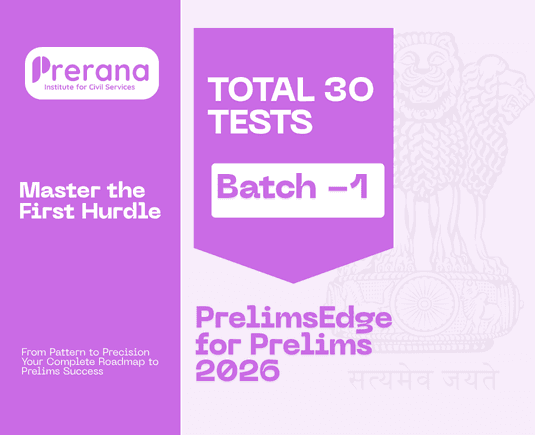
PrelimsEdge Batch-1 2026
PrelimsEdge Test Series is a complete and structured preparation program for the UPSC CSE. Aspirants will get 30 high-quality tests covering the entire UPSC syllabus through a three-tier system — Sectional, Comprehensive, and Full-Length Tests.
Aspirants will also receive in-depth explanations, test-wise analytics, Zero Hour strategy sessions, test breakdown discussions, and mentorship guidance.
Join NowComplete Guide to Cracking Economy
Our Indian Economy analysis is a fully structured, UPSC-aligned document covering complete syllabus breakdown, conceptual explanations, and 10-year question trends. Designed for aspirants who want clarity, depth, and exam-focused understanding in a single comprehensive source.
Read Now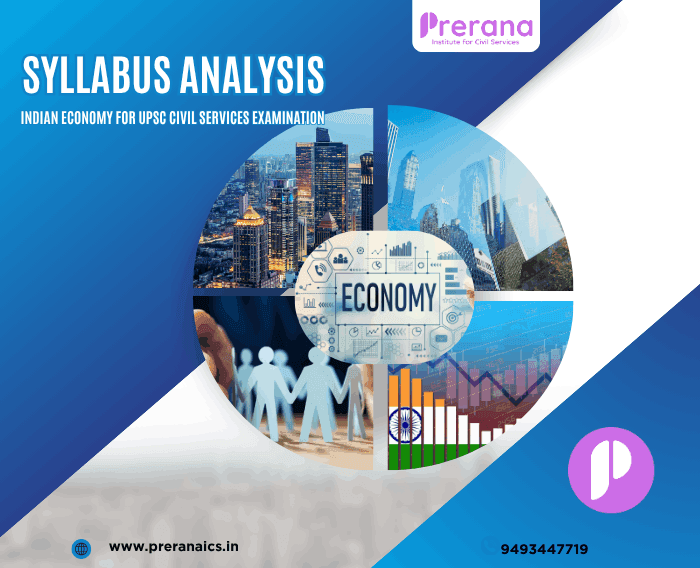
UPSC Civil Services Examination – Detailed Syllabus
Overview
The Civil Services Examination (CSE) conducted by the Union Public Service Commission (UPSC) is one of the most prestigious and competitive examinations in India.
It is held in three stages:
Preliminary Examination (Objective Type – Screening Test)
Main Examination (Written – Descriptive)
Personality Test (Interview)
Stage I – Preliminary Examination
Paper I: General Studies (GS) – 200 Marks
Duration: 2 Hours
Type: Objective (MCQs)
Negative Marking: Yes (⅓rd of marks deducted for wrong answers)
Syllabus:
*Current events of national and international importance
*History of India and Indian National Movement
*Indian and World Geography: Physical, Social, Economic Geography of India and the World
*Indian Polity and Governance: Constitution, Political System, Panchayati Raj, Public Policy, Rights Issues, etc.
*Economic and Social Development: Sustainable Development, Poverty, Inclusion, Demographics, Social Sector Initiatives
*Environmental Ecology, Biodiversity, and Climate Change (General issues, no subject specialization required)
*General Science
Paper II: CSAT (Civil Services Aptitude Test) – 200 Marks
Duration: 2 Hours
Type: Objective (MCQs)
Qualifying Paper: Minimum 33% marks required
Syllabus:
*Comprehension
*Interpersonal skills including communication skills
*Logical reasoning and analytical ability
*Decision making and problem-solving
*General mental ability
*Basic numeracy (numbers, orders of magnitude, data interpretation – charts, graphs, tables, etc.) – Class X level
*Data interpretation
Stage II – Main Examination
The Main Exam is written (descriptive) and consists of 9 papers. Marks in Papers A & B are qualifying, while Papers I to VII are counted for merit.
Qualifying Papers
(Not counted for merit, but compulsory to clear)
Paper A: Indian Language (300 Marks) – Any language from the Eighth Schedule of the Constitution
Paper B: English (300 Marks)
Merit Papers
Paper I – Essay (250 Marks)
Candidates may be required to write essays on multiple topics.
*Expected to stay close to the subject, arrange ideas logically, and write concisely.
*Marks given for clear, effective expression.
Paper II – General Studies I (250 Marks)
Indian Heritage and Culture, History and Geography of the World and Society
*Indian culture – Art forms, literature, architecture from ancient to modern times
*Modern Indian history (18th century till present): significant events, personalities, issues
*Freedom struggle – Different stages, contributors from different parts of India
*Post-independence consolidation & reorganization within the country
*World history – 18th century events, industrial revolution, world wars, redrawing of boundaries, colonization, decolonization, political philosophies (communism, capitalism, socialism, etc.)
*Indian society – Diversity, role of women, population, poverty, urbanization, social empowerment, communalism, regionalism, secularism
*Geography of India and the World – Physical geography, natural resources, key geophysical phenomena (earthquakes, cyclones, etc.), climate, flora & fauna, environmental changes
Paper III – General Studies II (250 Marks)
Governance, Constitution, Polity, Social Justice and International Relations
*Indian Constitution – historical underpinnings, evolution, features, amendments, basic structure, judicial review
*Functions & responsibilities of Union and States; federal structure, devolution of powers, finance, challenges
*Separation of powers; dispute redressal mechanisms
*Parliament & State Legislatures – structure, functioning, powers, privileges, issues
*Executive & Judiciary – organization, structure, functioning
*Appointment to constitutional posts; powers, functions, responsibilities
*Statutory, regulatory and quasi-judicial bodies
*Government policies and interventions for development
*Development processes and the role of NGOs, SHGs, civil society
*Welfare schemes for vulnerable sections – implementation, evaluation
*Issues related to health, education, poverty alleviation
*Role of pressure groups, associations, politics in democracy
*Representation of People’s Act
*International relations: India & neighbors, bilateral, regional and global groupings, international institutions, diaspora, global economic developments affecting India
Paper IV – General Studies III (250 Marks)
Technology, Economic Development, Bio-diversity, Environment, Security and Disaster Management
*Indian economy: planning, resource mobilization, growth, development, employment
*Inclusive growth and issues arising
*Government budgeting
*Agriculture – cropping patterns, irrigation, e-technology, issues of storage, transport, marketing
*Food processing & related industries
*Infrastructure – energy, ports, roads, airports, railways
*Investment models (PPP, etc.)
*Science & Technology: awareness, IT, space, robotics, nanotech, biotech
*Achievements of Indians in science & tech
*Environment: conservation, pollution, climate change, biodiversity, environmental impact assessment
*Disaster management: vulnerability, preparedness, mitigation
*Security: internal security challenges, terrorism, border security, cyber security, money laundering, organized crime
*Role of external state/non-state actors in internal security
*Security forces and agencies & their mandate
Paper V – General Studies IV (250 Marks)
Ethics, Integrity, and Aptitude
*Ethics and human interface: essence, determinants, consequences
*Human values – lessons from great leaders, reformers, administrators
*Attitude: influence, relation with thought & behavior
*Aptitude and foundational values of Civil Services – integrity, impartiality, non-partisanship, objectivity, dedication to public service, empathy, tolerance, compassion
*Emotional intelligence – concepts, utilities, applications
*Contributions of moral thinkers and philosophers from India and world
*Public/Civil service values & ethics in public administration: status, accountability, ethical concerns, corruption, work culture, quality of service delivery
*Probity in governance – RTI, codes of ethics, citizen charter, transparency, challenges of corruption
*Case Studies on above issues
Paper VI & VII – Optional Subject (2 Papers, 250 Marks each)
Candidate has to choose one optional subject from the UPSC list.
Examples include: Anthropology, History, Geography, Political Science & IR, Public Administration, Sociology, Psychology, Philosophy, Literature of Indian Languages, etc.
Stage III – Personality Test (Interview)
*Conducted by UPSC Board (275 Marks)
Tests candidate’s:
General awareness
Analytical ability
Communication skills
Ethical integrity
Leadership & decision-making qualities
No fixed syllabus; questions may range from current affairs to hobbies, optional subject, personal background, etc.
Final Ranking
Written exam (1750 marks) + Interview (275 marks) = 2025 marks
Candidates ranked based on total score.